What is Web3: The Evolution of Digital Ownership in Blockchain


Table of Contents
Share
 Listen to the article and dive into a detailed exploration of the topic
4 min read
Key Takeaways
- Web 3.0 is the most advanced form of the internet, primarily focused on user empowerment through decentralization, blockchain technology, and true ownership.
- As compared to Web 1.0, the content in Web 2.0 is user-generated. However, the ownership is still with the platforms, and they usually collect user data, affecting user privacy.
- The concept of Web 3.0 relies on decentralized networks. It heavily depends on blockchain technology that itself is a distributed ledger network.
- Web 3.0 integrates built-in economic models which are driven by the use of cryptocurrencies and token economies.
The world is changing too rapidly for people even to fully grasp, and so is the technology. A few years ago, everyone was captivated by Instagram, Snapchat, and other interactive platforms, and now artificial intelligence (AI) has taken centre stage. ChatGPT and Gemini are the most talked-about applications today, and OpenAI and GenAI are the most discussed technologies. This fascinating evolution of technology is correlated with the evolution of the Internet. From its inception in the 1990s to 2025, the internet has also come a long way.
Earlier, it was a medium of reading things only, such as gathering information about something, downloading a song, or viewing an image. There was not much user interaction with any person or application. Also, users had no contribution to the content that was published on the internet; only the people who owned or had access to the website could change the content. This Era of the internet came to be known as Web 1.0. After that, the internet evolved to become more interactive, user-centric, and then moved to decentralization and ownership. In this blog, we will discuss the journey from Web 1 to Web 3 and the evolution of digital ownership.
Web 3.0 Explained
Web 3.0 is the most advanced form of the internet, primarily focused on user empowerment through decentralization, blockchain technology, and true ownership. Statistically, the global market size of Web 3.0 was $3.17 billion in 2024, and it is projected to reach $99 billion by 2034. Web3 emphasizes making the internet decentralized so that no single entity controls the content and other information. It also promotes user privacy, anonymity, and enhanced security for data stored on any network.
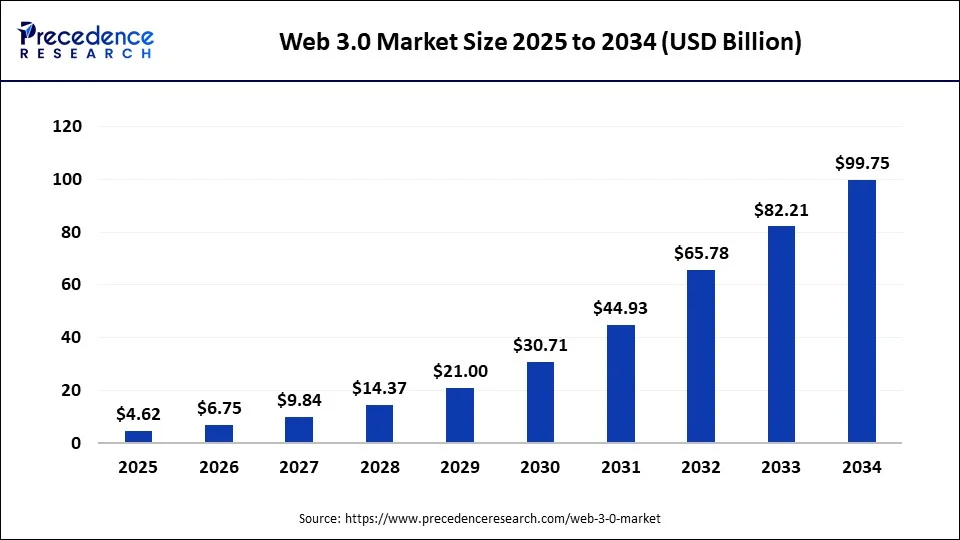
Cryptocurrencies and blockchain technology, along with smart contracts, are the primary components of Web3. Distributed ledger technology allows information to be stored in decentralized blocks, and smart contracts enable agreements to automatically take effect when predetermined conditions are met, reducing human intervention and thereby increasing transparency. Statistically, the global market size of Web 3.0 was $3.17 billion in 2024, and it is projected to reach $99 billion by 2034.
Web 2.0 vs Web 3.0
When the internet transitioned from read-only to read-write interactive mode, it was called the next phase of the internet, Web 2.0. It enabled people to connect and communicate with each other through social media platforms such as Facebook, WhatsApp, Twitter (now X), and Instagram. As compared to Web 1.0, the content in Web 2.0 is user-generated. However, the ownership is still with the platforms, and they usually collect user data, affecting user privacy.
Now, in the era of Web 3.0, the comparison with Web 1 is not correct, although we need to underline the stark differences between Web 2.0 and 3.0.
| Characteristics | Web 2.0 | Web 3.0 |
| Year | Early 2000s-Present | Still Evolving |
| Content | User-Generated | Decentralized |
| Ownership | Platforms | Users |
| Privacy | Platforms can collect user data | Primary focus on user privacy and data protection |
| Security | Standard Encryption | Cryptographic Mechanisms |
| Monetization | User-interaction, Social media | P2P model, dApps |
| Major Applications | Social Media and E-commerce platforms | DeFi, Tokenization |
Key Characteristics of Web 3.0
Even though Web 3.0 is far from completion, it has, however, changed the way people think of the internet due to the intuitive user experience, privacy, anonymity, decentralization, and ownership it offers and it is still making impact. Therefore, one could talk about the features of Web 3.0 as following:
Decentralization
The issue with Web 2.0 is the control of the platform owners, and the centralised platforms like Amazon, Facebook, and Google are the main players of Web 2.0. The concept of Web 3.0 relies on decentralized networks. It heavily depends on blockchain technology that itself is a distributed ledger network. Data is no longer kept on centralized servers but rather it is distributed among different nodes. Consequently, this change makes the whole process more clear, eliminates the risk of single points of failure and also strengthens the users’ empowerment as they get more control over their data and digital assets.
True Ownership
A Digital Ownership model is one of the hallmark features of Web 3.0. With the help of decentralized identifiers (DIDs), smart contracts, and blockchain-based tokens (like NFTs and cryptocurrencies), users are allowed to have the full control over their identities, data, and digital assets. Instead of platforms having full control over user data, now users are the ones who can give, take back, or even monetize the access if they want.
Semantic Understanding
Web 3.0 has the capability to access semantic web resources and has the ability to understand the data by the machine and also interpret the data with human accuracy concept. This leads to more intelligent search engines, personalized content, and the expansion of AI-driven services. Because the system grasps the context and the meaning of the content, instead of just focusing on keywords, Web 3.0 is able to provide the most related and correct results in different areas.
Interoperability
Web 3.0 applications such as dApps and other decentralized protocols have been developed in such a way to enable them to communicate with each other through APIs and smart contracts. Besides this, it also permits developers to use the existing facilities to create new products instead of starting from the ground, thus encouraging the flow of new ideas and cooperation.
Decentralized Governance Model
The Web 3.0 model has so many interesting features among which is an attribute that has got a decentralized governance model for these decentralized ecosystems which is controlled by token holders who can vote, hence they can come to the conclusion, decide on the content, protocol upgrades, funding proposals or rule changes within the network, as well as much other stuff.
Built-in Economic Models
Web 3.0 integrates built-in economic models which are driven by the use of cryptocurrencies and token economies. For example, users can get, trade, or use tokens within decentralized ecosystems without being banked on by traditional financial intermediaries. The likes of play-to-earn, decentralized finance (DeFi), and creator economies are nothing but native parts of the whole web experience.
Permissionless System
With the use of Web 3.0 technology, people are given the chance to attend to network functions like giving a hand to a DAO or issuing a token without the usually necessary go-ahead. The third generation of the World Wide Web is based on smart contracts that are self-operating agreements hence no need for a middleman.
Enhanced Privacy
Web 3.0 is implemented with several cryptographic methods such as zero-knowledge proofs, homomorphic encryption, and blockchain consensus mechanisms. It comes with tighter privacy and security mechanisms, which allow users to communicate, trade, and verify themselves without having to expose their sensitive personal information, thus the possibility of them becoming targets to surveillance or data exploitation is greatly minimized.
Why Delta6Labs Stands Out in Web 3.0 Innovation
Delta6Labs is a leading company that caters to the needs of the Web 3.0 sector by providing a wide array of innovative FinTech and Web 3.0 solutions. Its services are distinguished by the feature-rich and beautiful user interface, the wide variety of blockchain choices and the scalable offerings that are the products of the company’s combination of expertise and innovative spirit.
Conclusion
The evolution from Web 1.0 to Web 3.0 signifies a transformative shift in how we interact with the internet. While Web 1.0 was static and read-only, and Web 2.0 introduced user-generated content with centralized ownership, Web 3.0 emerges as a paradigm focused on decentralization, true digital ownership, and enhanced privacy.
By leveraging cutting-edge technologies like blockchain and smart contracts, Web 3.0 empowers users, fosters innovation, and promotes collaborative ecosystems. As we continue to navigate this rapidly changing landscape, embracing these advancements will be essential for ensuring a more secure, transparent, and user-centric internet experience in the years to come. The journey towards a truly decentralized internet is just beginning, and its potential is limitless.
Frequently Asked Questions
Web 2.0 is centralized and dominated by major tech companies, whereas Web 3.0 is decentralized and driven by the community. In Web 2.0, users are considered the product; in contrast, Web 3.0 allows users to own their data and digital assets, often utilizing blockchain technology and smart contracts.
No, but they are closely related. Blockchain is a foundational technology behind Web 3.0. While blockchain enables decentralization, Web 3.0 includes additional elements like AI, semantic data, and user-controlled identity to create a more innovative, more private internet.
Web 3.0 is built on blockchain technology, smart contracts, and other decentralized protocols, which makes the data stored on a network secure and immutable.
Delta6Labs provides a user-friendly interface, multiple blockchain options, and scalable Web 3.0 solutions that are designed with innovation and expertise.
DeFi, NFTs, DAOs, supply chain management, healthcare, voting systems, and energy trading are some real-life examples of Web 3.0.
Disclaimer:
The information on this blog is for knowledge purposes only. The content provided is subject to updates, completion, verification, and amendments, which may result in significant changes.
Nothing in this blog is intended to serve as legal, tax, securities, or investment advice of any investment or a solicitation for any product or service.
 Trending Topics