Key takeaways
- The role of HFT systems is simple but critical: keep markets liquid, tight, and functional, even when humans are sleeping.
- High-frequency trading firms run algorithms on multiple exchanges at the same time, thus price discrepancies are fixed within milliseconds.
- HFT is the one that assures enough depth for a large volume execution that is comfortable.
- High-frequency trading (HFT) firms are the ones who can provide scalable liquidity that can grow along with the exchange.
If you’ve been around the crypto space long enough, you’ve probably heard the term High-frequency trading, or simply HFT. For some, it sparks curiosity; for others, it brings images of supercharged algorithms racing through stock markets at lightning speed. But in the world of crypto, which never sleeps and rarely pauses, High-frequency trading (HFT) plays an even more fascinating, impactful role.
Today, let’s break down why HFT matters so much for modern crypto exchanges, what it means for everyday traders, and why it’s becoming the backbone of institutional participation. We’ll walk through the technology, the human side of the story, and the future path — all in a way that makes sense whether you’re a builder, a trader, or simply crypto-curious.
What Is High-Frequency Trading (HFT)?
High-Frequency Trading (HFT) is an automated form of algorithmic trading that uses powerful computers to transact many orders at extremely fast speeds. HFT firms compute real-time market data, detect minuscule price mismatches and trade them in before human traders can respond. These strategies are typically built around orders on local exchanges or connected to the same servers as those used by exchange servers for faster order execution. Positions are often held for extremely short durations, occasionally just milliseconds, to take advantage of minute price fluctuations.
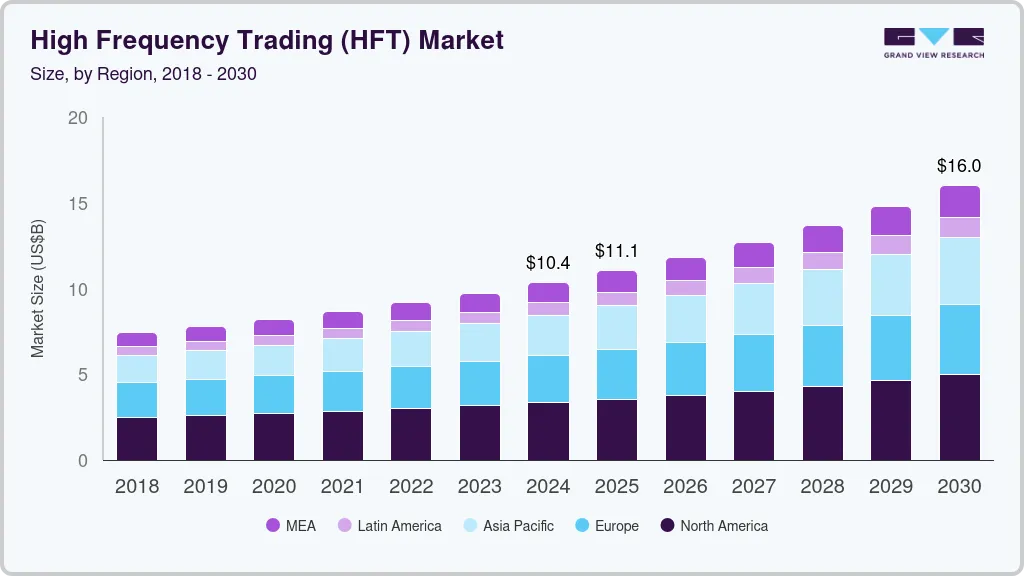
The global high frequency trading market size was valued at USD 10.36 billion in 2024 and is expected to reach USD 16.03 billion by 2030, growing at a CAGR of 7.7% from 2025 to 2030.
The 24/7 Nature of Crypto Demands Something Faster
Traditional markets take breaks. Crypto markets… don’t.
This round-the-clock trading environment means liquidity, price discovery, and market stability must continue at all hours, whether it’s 3 a.m. on a Sunday or during peak Asian market hours. Human traders can’t sustain that pace. Even most retail bots fall short.
This is where HFT enters the picture. High-frequency systems operate at speeds measured in microseconds, capable of placing and cancelling thousands of orders per second. The role of HFT systems is straightforward yet vital: to maintain liquidity, keep spreads tight, and ensure markets operate smoothly, even when human traders are offline. Without HFT, crypto books would look very different:
- Wider spreads
- Slower price adjustments
- Higher volatility
- Low liquidity at odd hours
In short, HFT acts like a stabilising backbone, quietly maintaining order in markets that never turn off.
Advantages of High-Frequency Trading (HFT)
Many people think that high-frequency trading (HFT) only gives an advantage to sophisticated funds or quants. However, what is really surprising is the extent to which retail traders are indirectly benefiting from high-frequency trading activities. That is the way:
Tighter Spreads
By continuously placing buy and sell orders at various price levels, High-frequency trading (HFT) firms effectively bring the bid and ask prices to a closer level. This results in lower transaction costs for everyone, e.g. a person making a $50 trade.
Faster Price Discovery
Being global and highly decentralized, Crypto is full of arbitrage opportunities that can arise every second. HFT firms run algorithms on multiple exchanges at the same time, thus price discrepancies are fixed within milliseconds. This guarantees that prices remain fair at any location of trading.
Deeper Liquidity
More liquidity means:
- Faster order execution
- Lower slippage
- Flash crashes become more rare
Such developments make digital currencies less risky and more attractive for both newcomers and institutions.
Lower Volatility
It is somewhat ironic that the same speed which is sometimes used as a reason for negative effects is also the speed that contributes to market stability. HFT algorithms therefore respond immediately, absorbing liquidity and thus preventing large price gaps, when massive buy or sell orders are placed.
A world full of a thousand retail traders entering during hype cycles, would not be as great if High-frequency trading (HFT) were not there to keep it calm and orderly.
Why Crypto Exchanges Need HFT to Stay Competitive
A user, when picking an exchange, does not always consider liquidity or order-book depth. They only look for quick trades and minimal slippage. However, the secret cash behind that easy user experience is very often active HFT market makers. For the exchanges, it is not a question whether to attract the HFT activity but a necessity to be successful. Here is the reason why:
Enhances Exchange Reputation
Users instinctively move to platforms where the market is vibrant. A thin order book deters traders, while a deep one draws more of them.
Makes It Possible for Large Traders to Take Part
Institutional desks and whale traders require liquidity to carry out a large order without causing too much of a market change. High-frequency trading (HFT) is the one that assures enough depth for a large volume execution that is comfortable.
Gives the Opportunity to List New Tokens
Most of the time, new tokens are illiquid. By cooperating with High-frequency trading market makers, exchanges can start a token listing with a stable order book from the very first day.
Facilitates the Implementation of Scalable Growth
When the trading volume increases, all human and amateur algorithmic activities are not able to keep up with the pace. HFT firms are the ones who can provide scalable liquidity that can grow along with the exchange.
Invites Innovation
There are exchanges that provide co-location, low-latency APIs, and advanced order types to attract the best HFT firms. These novelties not only lead the entire platform to the next level but also enhance the infrastructure and user features.
In a lot of respects, the strategy of attracting HFT firms can be compared to that of getting the first tenants in a new mall. After they come, the others are not far behind.
The Rise of HFT in Crypto Exchanges
One may easily imagine HFT as one big machine that keeps on trading ceaselessly without human intervention. Nevertheless, the usage of crypto has changed the very concept of high frequency strategies. HFT in crypto nowadays is divided into various classes:
- Cross-Exchange Arbitrage: It is a method of trading that “completes” the inefficiencies between exchanges in a very short period (few milliseconds).
- Market Making: Act of providing liquidity continuously both on the bid and on the ask sides of the order book.
- Latency Arbitrage: It is to exploit delays in price updates at the millisecond level.
- Statistical Arbitrage: Applying machine learning algorithms and using probabilistic models to find statistical patterns in the short-time frame that can be exploited.
- Perpetual Funding Rate Arbitrage: A method of balancing spot and perpetual contract prices that is only possible in crypto derivatives.
- Tokenised Asset Arbitrage: As an example, differences between the tokenized real-world assets and the non-tokenized versions.
The number of these strategies shows that the crypto ecosystem is still a kind of youth and is very dynamic. The existence of new tokens, new chains, and new derivatives continuously opens the door to the possibilities of HFT while at the same time posing challenges to such strategies.
Challenges of High-Frequency Trading in Crypto
High-frequency trading, while it has the ability to revolutionize trading, has to grapple with various problems that are characteristic of the crypto world:
- Extreme Volatility: Basically, any 20% sudden change in the market can make the trading models obsolete right away.
- Exchange Outages: If a technical problem occurs at an exchange during a period of high volatility, it can bring down the whole trading system.
- Latency Differences Between Chains: The time it takes for different blockchains to confirm a transaction varies a lot which makes the process more complicated.
- Regulatory Uncertainty: The rules of High-frequency trading in crypto are very different from one jurisdiction to another.
- Fragmented Liquidity: There are hundreds of exchanges, each of them having different APIs, fee structures, and performance characteristics.
These obstacles provide opportunities for innovations to happen, and they are the reasons why many leading crypto exchanges are willing to spend a lot on infrastructure to keep HFT firms interested.
Build Smarter High-frequency trading (HFT) Systems with Delta6Labs
Delta6Labs is a leading Web3 development company focused on high-frequency trading (HFT), providing low latency infrastructure, and algorithmic trading systems and quantitative strategies in digital asset markets. The company builds, designs, and deploys high-capacity engine, which can process terabytes of unique market data in the matter of microseconds, facilitating sophisticated market making, cross-exchange arbitrage, and optimal execution.
Final Words
High-frequency trading is mainly hidden from the view of an average user. However, its effects can be felt everywhere: in lower spreads, more efficient trades, and markets that survive even in severe storms of volatility. As crypto keeps developing into a financially global integrated ecosystem, HFT will be necessary to take the lead only.
Speed is not the only thing that matters. It is also a question of stability, efficiency, fairness, and maturity.
There are the modern crypto exchanges that realize this fact and choose to invest in the creation of infrastructures that are appealing to HFT companies, which are leading the way to the coming years of digital finance.