MT5 Broker CRM: Best Practices for Launch, Security & Scale


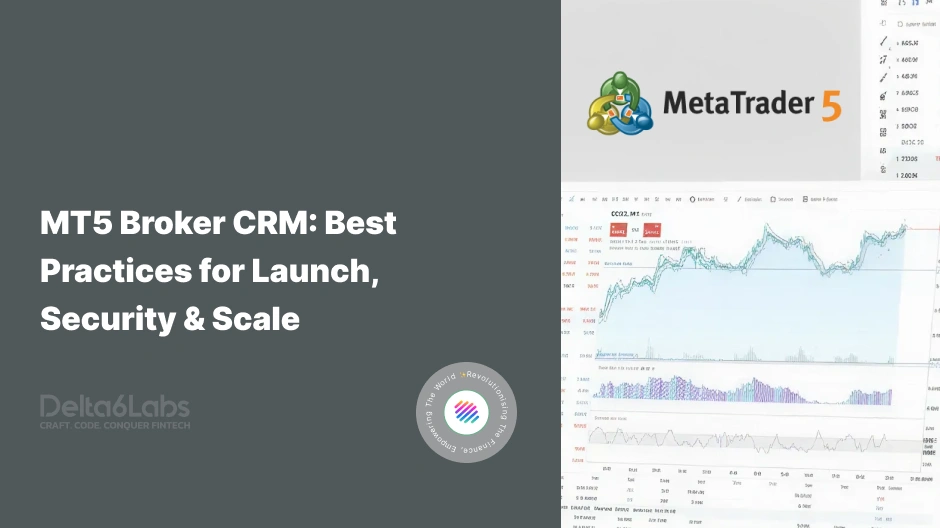
Table of Contents
Share
 Listen to the article and dive into a detailed exploration of the topic
4 min read
Key Takeaways
- MT5 broker CRM (customer relationship management) is a software system designed for brokers running their business on the MetaTrader 5 platform.
- A broker’s customer relationship management (CRM) system must implement strong authentication, encrypted data storage, and role-based access controls
- To improve operational efficiency and ensure regulatory compliance, the CRM should automate the onboarding and KYC (Know Your Customer) workflows.
- Delta6Labs follows all standard practices to build its MT5 broker CRM solutions. Whether it is defining the purpose of the CRM or choosing the type, our research team conducts thorough market research to plan the subsequent strategy.
Trading is no longer an elitist thing, nor is it limited to tech-savvy people. Advanced technology has entirely changed the trading landscape by making it accessible to everyone in the world with access to an internet connection and a mobile device. People are actively participating in various types of trading, including forex, stocks, commodities, futures, crypto assets, etc. With a significant increase in the number of traders, businesses, and brokerage firms are also blooming.
Multiple software programs emerged to help traders and brokers streamline their trading businesses. However, Brokerage firms were initially facing issues, such as the need for a separate platform for forex trading, commodity trading, and cryptocurrency trading. Traders needed external tools for news and economic indicators. MT4 software was limited in functionality for complex bots or indicators, and strategy optimization was also weak. But MT5 software has resolved these pain points. However, managing clients is still an issue that is troubling brokers, which is why CRMs are introduced to help brokers manage their clients and orders. In this blog, we will discuss everything we need to know about MT5 broker CRM.
What is an MT5 Broker CRM?
MT5 broker CRM (customer relationship management) is a software system designed for brokers running their business on the MetaTrader 5 platform. MetaTrader 5 (MT5) is the successor to MetaTrader 4 (MT4) and offers more advanced features, improved performance, and support for a wider range of asset classes. It’s used for Technical and fundamental market analysis, Algorithmic trading using Expert Advisors (EAs), copy trading, risk management, and trade execution.
Best Practices for Launching an MT5 Broker CRM
Here are the best practices for launching an MetaTrader 5 broker CRM:
Define Clear Business Objectives
The first best practice in launching an MT5 Broker CRM is to define a clear brokerage model. This includes identifying whether the brokerage will operate under a full license, a white-label arrangement, or a hybrid setup. Each model has different technical and regulatory implications.
It’s crucial to determine which markets to target, which financial instruments to offer (such as forex, stocks, crypto, or commodities), and which languages and currencies the platform must support. These choices will influence the CRM’s structure, integrations, and workflows. Without this fundamental clarity, brokers risk selecting or customizing a CRM that doesn’t align with their long-term operational or regulatory needs.
Choose an MT5-Compatible CRM Platform
Once the business model is established, the next step is to select a CRM solution specifically designed for the MT5 environment. Not all CRMs are created equal; using a generic tool like Salesforce or Zoho can result in costly customizations and limited functionality. Brokers should seek CRMs that offer native integration with MT5 Manager APIs.
This integration ensures that account activities, such as deposits, trades, withdrawals, and balance updates, are synchronized in real time. Top-tier providers, such as B2Broker, UpTrader, TFB, Delta6Labs, and Skale, offer robust solutions that have been tested across hundreds of live brokerages.
Automated Compliance Model
To improve operational efficiency and ensure regulatory compliance, the CRM should automate the onboarding and KYC (Know Your Customer) workflows. Brokers can enhance this process by integrating third-party KYC providers directly into the CRM. This integration allows new clients to upload identity documents, complete biometric verification, and receive approval within minutes, eliminating the need for manual review unless necessary.
Automated risk scoring and document validation significantly reduce human error and accelerate the onboarding process, enabling traders to start trading sooner while ensuring that the firm remains compliant with AML (Anti-Money Laundering) regulations and international standards.
Integrate Payment Gateways
A robust payment system must support seamless integration with various payment options. The easier it is for clients to deposit and withdraw funds, the greater the likelihood of retaining them and increasing trading activity. Brokers should ensure that their Customer Relationship Management (CRM) systems are compatible with major payment gateways, bank transfers, e-wallets, and even cryptocurrency payment providers. These systems should connect via secure APIs and include features such as automated approval workflows, fraud detection tools, and real-time status updates. Manual processes can increase errors and delays, which may frustrate users and damage brand trust.
Automated Customer Communication
Client communication is a crucial component that is often overlooked. The CRM should include automated messaging capabilities to engage users throughout their lifecycle. For instance, it can send a welcome email upon registration, follow-up SMS reminders to complete KYC (Know Your Customer) requirements, or inactivity alerts to re-engage dormant users. Marketing teams can segment users based on behaviour, region, or trading volume and deploy targeted campaigns accordingly. Effective communication enhances user satisfaction and increases lifetime value, all without the need for manual follow-ups.
Level Up Security Protocols
Security and data privacy are essential in the financial industry. A broker’s customer relationship management (CRM) system must implement strong authentication, encrypted data storage, and role-based access controls. Two-factor authentication (2FA) should be mandatory for administrators and strongly recommended for clients. Additional measures, such as IP whitelisting, session timeouts, audit trails, and adherence to GDPR-compliant data handling, are now standard expectations.
Intensive Testing
Before launching, brokers should conduct thorough testing of the entire CRM system in real-world scenarios. This includes simulating client sign-ups, KYC submissions, fund transfers, support tickets, and syncing high-volume trades. Any bugs, slow loading times, or integration errors must be addressed before the launch.
Enterprise-Grade MT5 Broker CRM Solutions by Delta6Labs
Delta6Labs follows all standard practices to build its MT5 broker CRM solutions. Whether it is defining the purpose of the CRM or choosing the type, our research team conducts thorough market research to plan the subsequent strategy. We follow AML/KYC protocols and prioritize security in our MetaTrader 5 broker CRM platforms. Additionally, Delta6Labs is known for providing quality projects within a given timeframe.
Conclusion
Employing an MetaTrader 5 Broker CRM is essential for modern trading firms looking to enhance their operational efficiency and client management. By defining clear objectives, selecting an MT5-compatible platform, automating compliance, integrating payment gateways, and facilitating automated communication, brokers can create a streamlined experience for both clients and themselves. As the trading landscape continues to evolve, leveraging these best practices not only improves regulatory adherence but also fosters client satisfaction and loyalty. Embracing the right CRM solutions ultimately helps brokers achieve success in the competitive financial market.
Frequently Asked Questions
MT5 provides advanced features, higher operational speed, and effective order management as compared to MetaTrader 4.
It is necessary to define a clear objective before building an MT5 broker CRM because it helps in planning and building a strategy for development and promotion. It prevents feature bloat, reduces development costs, and enables scalable, compliance-ready growth.
A dedicated MT5 CRM ensures real-time synchronization with MT5 servers, automates workflows like KYC, deposits, and reporting, and improves operational efficiency and regulatory compliance.
Before launching, brokers should conduct thorough testing of the entire CRM system in real-world scenarios. This includes simulating client sign-ups, KYC submissions, fund transfers, support tickets, and syncing high-volume trades. Any bugs, slow loading times, or integration errors must be addressed before the launch.
When it comes to online trading, the ability to access a variety of trading tools, and to access more global markets than your traditional stockbrokers, MT5 is an excellent trading platform. However, if you are starting, a demo account might be a great first step when finding a reputable brokerage.
Disclaimer:
The information on this blog is for knowledge purposes only. The content provided is subject to updates, completion, verification, and amendments, which may result in significant changes.
Nothing in this blog is intended to serve as legal, tax, securities, or investment advice of any investment or a solicitation for any product or service.
 Trending Topics