Custom Crypto Trading Platform Development: From Idea to Deployment



Table of Contents
Share
 Listen to the article and dive into a detailed exploration of the topic
5 min read
Key Takeaways
- Custom trading software is a customized software application designed to meet the specific needs of traders, brokerage firms, and businesses.
- One of the key benefits of custom trading software is speed. The crypto market is highly volatile and can move dramatically in milliseconds, and a custom platform optimized for low latency can capture opportunities before they vanish.
- In custom trading software, people can customize the infrastructure for the expected load and reduce per-trade costs.
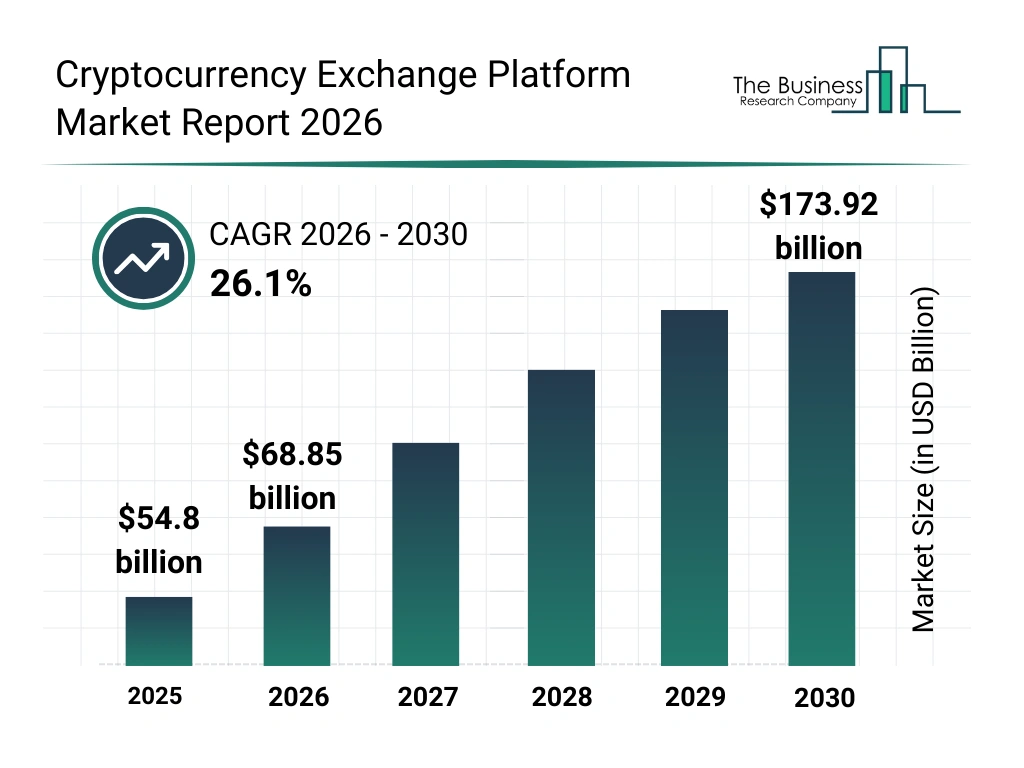
As the cryptocurrency market matures into the world’s second-largest marketplace, competition within this sector increases due to the rise of new trading systems developed over the past decade. Crypto companies and individual traders are increasingly focused on creating unique trading experiences to differentiate themselves from others. The cryptocurrency exchange platform market is projected to grow from $54.8 billion in 2025 to $68.85 billion in 2026 at a CAGR of 25.6%, and is expected to reach $173.92 billion by 2030 at a CAGR of 26.1%.
While there are currently many solid crypto trading platforms available to customers, it is difficult for users to find a platform that provides the speed, flexibility, and functionality needed to optimize their trading activities. In this piece, we will examine the increasing demand for customized cryptocurrency trading platforms by individuals and businesses, while also exploring some of the implications and effects of an expanding crypto marketplace.
Defining Custom Trading Platforms
Custom trading platform, commonly referred to as custom trading, refers to an online or offline software application that allows users to conduct trades via an online exchange, as well as manage all aspects of their account on behalf of users. The purpose of developing a customized trading platform is to allow users to have the fullest control possible over their trading environments, as well as to provide users with tools for managing risk and access to valuation and analytics services.
In addition to providing users with additional capabilities beyond what is available through existing trading platforms, custom trading software development companies also provide users with the tools needed to make trades quickly and efficiently, while providing users with access to real-time data and updates about their investments from around the world.
In fact, the demand for custom trading platforms in the global cryptocurrency marketplace has increased exponentially in the last year, and several leading custom software companies, including Delta6Labs, have begun developing custom trading software solutions.
What is The Need for Developing Custom Trading Software?
The crypto market never sleeps and is full of sharp price swings as well as various centralized and decentralized exchanges. Serious traders, be they high-frequency scalpers, algorithmic traders, or arbitrage specialists, may find standard retail platforms restrictive and detrimental to their trading potential. With custom software, traders can directly connect with the APIs of several exchanges, carry out their strategies at a higher speed, and use unique trading algorithms that are not available in public platforms.
Businesses like crypto hedge funds, proprietary trading firms, and advanced retail traders are the ones who mostly require ultra-low latency execution, automated risk management, custom portfolio analytics, and advanced arbitrage capabilities. By writing their software, they get a completely customized setup that matches their trading style, security requirements, and compliance obligations.
Benefits of Custom Trading Software
These are the benefits of custom trading software:
Low Latency and High Speed
Speed is one of the main points to highlight in a custom trading software. The crypto market is incredibly volatile, and the value can go up or down massively in a matter of milliseconds. Thus, a tailored platform specifically optimized for low latency will be able to get the windows before they shut. Direct exchange connectivity and efficient order-routing algorithms allow traders to gain a competitive advantage in high-frequency trading.
Security
Security is an important point as well. By means of the increasing cyber threat situations that target the exchanges and the wallets, customers who decide to build their platforms from scratch can integrate hardware wallets, multi-signature authentication, cold storage, and encrypted key management components in their platforms and hence minimize the risk of hacks.
Integration and Automation
The integration is also a very important factor, just like the automation. With the help of the custom platform, one can collect the data from various CEX and DEX, standardize it, and present a combined order book. Besides the arbitrage, this also enables the user to get an instant view of liquidity and market depth across the crypto world.
Scalability
With custom crypto trading software, the users will be able to design the data pipeline in accordance with the anticipated traffic and thus take a smaller fee per trade. This is by far the best advantage that custom crypto trading software can offer.
Step-by-Step Guide to Building a Custom Trading Software
Building custom trading software is not a simple task, but rather one that consists of many steps, and here we will explain this process step by step:
Define Objective
The very first step is to gather information from different stakeholders such as traders, quantitative analysts, compliance teams, and IT specialists. This stage helps to determine what the new platform is going to achieve, in particular, the kinds of assets to be traded, necessary order types, feed data specifications, latency targets, and regulatory requirements. The user stories and success metrics are worked out in detail so that everyone has a common understanding of the vision.
Architecture Planning
Once the requirements have been set, the next step is to select the system architecture. To get a low-latency execution, developers often choose such languages as C++ or Rust for the core engine, while user interfaces and higher-level services can be written with Python, Go, or JavaScript. The place where the system will operate, whether on-premises, cloud, or hybrid, is determined by factors such as performance, scalability, and price.
Prototyping and Proof of Concept
The new system concept is tested by a minimal prototype. It can be a minimal execution pipeline that takes care of market data, runs a sample strategy, and does the simulated trades. The main objective here is to confirm latency, data integrity, and exchange connectivity before broad development is initiated.
Core Development
The core development stage is the most comprehensive one, and it comprises the building of the market data module, execution engine, strategy layer, risk controls, and user interface. Market data systems convert and store the incoming feeds, while the execution engine takes care of order routing and trade confirmation. Risk modules facilitate compliance through pre-trade checks and position limits, and the strategy layer embeds the firm’s algorithms for fully or semi-automated trading.
Quality Assurance & Software Testing
Testing is done at every stage of the development process, and it is one of the most important activities. Unit and integration tests are done to make sure that individual components work correctly, while stress tests evaluate system performance under heavy loads. Historical backtesting and forward simulation are used to verify that strategies behave correctly in different market conditions. Security audits are performed to uncover vulnerabilities ahead of the launch.
Deployment
The deployment process is a beta or simulated environment at first in order to lessen the risk. The system is slowly deployed to live markets with a small amount of capital. Performance is being carefully monitored, which allows for the necessary adjustments before full-fledged operations are carried out.
Maintenance and Updates
The platform, after deployment, is not completely done and still requires constant attention in terms of performance, reliability, and security. Periodic updates add new features, optimize execution algorithms, and handle regulatory changes. Continuous improvement ensures that the platform remains competitive in a fast-paced trading environment.
Future Prospects of Custom Trading Software Development
Not only is custom trading software development helping to change the global finance industry drastically, but it is also the main factor responsible for the changes staying relevant in the future.
It is quite probable that the subsequent generation of crypto trading platforms will feature a combination of AI-driven analytics with Decentralized Finance (DeFi) integrations. Indeed, machine learning models may forecast short-term market moves, optimize portfolio allocation, and spot anomalies that could be manipulation or unusual trading activity.
Furthermore, decentralized exchange aggregation will be the standard practice, enabling traders to route orders to get the best price at numerous DEXs without physically looking into each one. Thanks to blockchain interoperability protocols, cross-chain trading will have no limits in the number of assets available from one interface.
Moreover, security will come a long way with innovations such as multi-party computation (MPC) wallets, biometric authentication, and hardware-accelerated encryption. As institutional adoption increases, be ready for more hybrid platforms that not only offer the speed of centralized execution but also the security of decentralized custody, which will be the next trend.
Delta6Labs: An Expert in Custom Trading Software Development
Delta6Labs focuses on widespread cryptocurrency software exchange adapted to high-frequency and other global trading strategies. Utilizing its extensive experience in low-latency systems, exchange integration, automation, and security-oriented architecture, we can help traders, enterprises, and companies to take the lead in rapidly changing crypto markets.
Final Words
Custom trading software development is not just about creating another trading terminal; it’s about gaining a competitive advantage in one of the fastest-moving financial markets in history. A well-designed platform provides superior execution speed, deep market integration, advanced security, and a trading experience precisely customized to the user’s strategy.
While the journey from defining an objective to deployment can be challenging, the payoff is a trading system that adapts to market changes, protects proprietary strategies, and maximizes trading opportunities. In a 24/7 market where milliseconds matter, custom software is no longer a luxury; it’s a necessity for those serious about dominating the crypto trading game.
Frequently Asked Questions
Some of the primary risks are security vulnerabilities, unreliable exchange APIs, changes in regulations, and ongoing maintenance costs. These can be minimized in the face of what is probably strong planning, continuous updates and experienced development teams.
This measure is to ensure that the custom trading software fits on the basis of load. Traders can leverage high-frequency trading advantages with direct exchange connectivity and order-routing algorithms that make it easier for them to gain a competitive advantage.
Yes. The majority of custom solutions combine multiple CEXs and DEXs to aggregate liquidity, create arbitrage opportunities and allow for better market coverage.
It is a great choice for professional traders, crypto-based hedge funds, proprietary trading firms, and other businesses requiring specialized tools. Even further, retail traders who are experienced and require specific strategies or automation that is not offered on public systems will find much value in constructing their own system.
When developed properly, custom trading software can be quite secure. It also ensures higher security options like encrypted key storage, hardware wallet integration, multi-sig authentication, cold vaults and constant monitoring to maintain a secure network.
Disclaimer:
The information on this blog is for knowledge purposes only. The content provided is subject to updates, completion, verification, and amendments, which may result in significant changes.
Nothing in this blog is intended to serve as legal, tax, securities, or investment advice of any investment or a solicitation for any product or service.
 Trending Topics