Key Takeaways
- A Matching Engine serves as the backbone of the trading system, processing and executing buy/sell orders with unmatched speed and precision, ensuring liquidity, transparency, and a seamless trading experience.
- Exchanges with high-performance matching engines can handle millions of transactions per second, reducing latency and ensuring that trades are matched fairly using algorithms like price-time priority.
- Matching engines use algorithms such as FIFO (First In, First Out), pro-rata, and price-size priority to determine which orders to execute first, optimizing liquidity and order fulfillment.
- Built using high-performance languages like C++, Rust, or Go, modern matching engines are designed with microservices and in-memory processing for maximum scalability and uptime, even during market surges.
- The next evolution of crypto trading will include AI-powered trade optimization, multi-chain liquidity aggregation, and quantum-safe security, enabling faster, smarter, and more secure decentralized trading experiences.
What this currency-agnostic component looks like will vary depending on who you ask, but cryptocurrencies are bought and sold 24/7 across global markets, their liquid nature regulated by an invisible hand: the matching engine. Beneath the surface of a crypto exchange lies this technological core that quietly processes millions of buy and sell orders, leading to instant, accurate, reliable order execution for its traders.
As our human heart keeps us alive by pumping blood, the matching engine works hard within each crypto exchange to stay functional and run trades in real time. According to the reports, market projections related to matching engines are majorly positive, and the global market size of the matching engine industry was valued at 1.2 billion USD, which is expected to reach at $3.8 billion by 2033.
In this blog, we will first familiarize ourselves with what a matching engine is and how it works, along with the various types of algorithms that it uses, followed by an explanation of why it plays such an important role in upholding trust and efficiency in crypto trading.
What is the Matching Engine?
A matching engine is the core system behind every crypto exchange. It matches buy with sell orders according to established criteria (price/time priority). When you create a purchase order for Bitcoin at a defined price point, the matching engine searches its database for any existing sell orders that match your criteria.
If the matching engine finds one, it will execute the trade immediately; if it does not find one, your order will be placed into the ORDER BOOK until a match is found by another trader. This process is repeated thousands of times per second all over the world, which maintains market activity and liquidity and provides an efficient marketplace.
How Does a Matching Engine Work?
A matching engine works in a methodical workflow with multiple steps. This is how it works step by step:
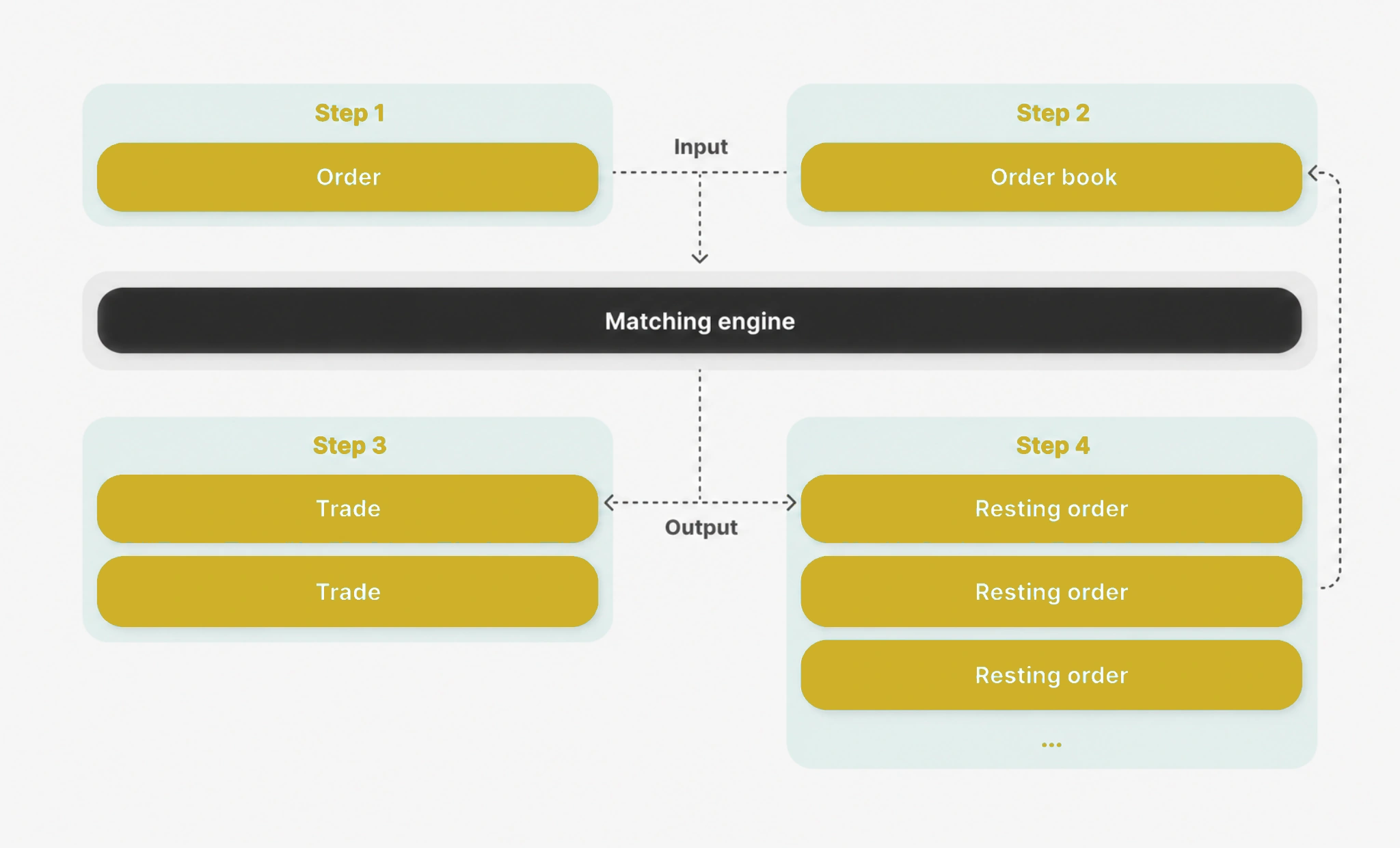
Order Placement and Validation
As soon as a trader, e.g., puts an order saying “buy 1 BTC at $92,500”, the order will be added to that exchange’s order management system (OMS), performing key checks before processing:
- Has the user account been sufficiently funded?
- Order type: limit, market, stop-loss -> is it valid?
- Does it meet the rules and regulations of trading on an exchange?
The order is only sent to the matching engine after these checks have been carried out.
Order Comparison and Matching
The matching engine constantly keeps an eye on the order book, which contains all unfulfilled buy & sell orders.
- Bids or buy orders – this lists the prices buyers are willing to pay.
- These are the sell orders (asks): X shows the price at which a seller is willing to sell.
The engine can compare both sides in real time. If a buyer places a bid that meets or surpasses the ask of a seller, the trade will be executed immediately via an instant matching at the best available price.
Trade Execution
When one is found, the engine executes the transaction, adjusts balances, and clears both matched orders from the book.
Order Queuing
An order stays in the order book until conditions are right to create an immediate match. In fluctuating markets, this queue can shift in the blink of an eye!
The complete ordering and execution process might happen in microseconds. These parameters directly affect the level of performance and the user experience of how the exchange works, when users connect to it.
Types of Matching Engine Algorithms
This is where matching engines come in, as they follow a set of rules when it comes to filling orders originating from multiple buyers or sellers at the same price level. How liquidity and fairness are handled within an exchange is determined by the choice of algorithm.
Price-Time Priority (FIFO)
This is the most popular method (First-In, First-Out FIFO). First-in-first-out (FIFO) price-time priority: Orders are prioritized first by the limit price and then by submission time.
- The lowest offer (buy) and the highest bid (sell) are always prioritized.
- If two traders have issued a price, the order that was placed earlier gets filled first.
This mechanism promotes fairness and gives traders an incentive to act quickly.
Pro-Rata Matching
Mainly seen on futures and derivative exchanges, this relies on allocating available volume evenly across all traders offering the same price.
As an example, if two traders place equal-priced buy orders for 10 BTC and 5 BTC respectively, and a sell order for 7 BTC appears in the system, both buyers are filled proportionally.
Price-Size Priority
This means that, when there are multiple orders at the same price level, larger orders will be taken care of first. This incentivizes traders to place larger orders, leading to increased liquidity in the order book.
Depending on whether the aim of your exchange is fairness, liquidity, or efficiency, that might determine a choice of matching algorithm.
Key Features of An Advanced Matching Engine
A well-engineered matching engine always provides speed, scale, and reliability. Take a look at the standout features that make it effective:
Ultra-Low Latency
And in crypto, every millisecond counts. Over 1000 transactions / second with a max latency in microseconds to not slip and miss the opportunity on a matching engine.
Scalability
Crypto markets are growing exponentially. A scalable engine will be able to accommodate growing trading volumes without degrading performance, by serving retail and institutional traders at the same time.
High Throughput
High-end engines are capable of executing millions of transactions every second without trading compression on the side of the engine during busy market conditions.
Fairness and Transparency
The matching engine follows its algorithmic rules without any manipulation. Transparency establishes trader confidence and safeguards market integrity.
Fault Tolerance
Downtimes are not acceptable because exchanges run 24/7. They need to include redundant systems and failover mechanisms so that the trading matching engine can continue functioning despite failures in some part of the system.
Auditability
Compliance and Regulatory Audits – Every transaction needs to be documented. Logging accurately is critical to maintaining accountability and building trust.
Centralized vs. Decentralized Matching Engine
Centralized Exchanges (CEXs)
Most centralized exchanges (like Binance, Coinbase, and Kraken) use powerful off-chain matching engines. These systems can handle millions of orders per second, ensuring lightning-fast execution. However, users must trust the exchange to manage orders fairly and securely.
Decentralized Exchanges (DEXs)
DEXs rely on blockchain-based smart contracts for order matching and settlement. While they offer transparency and self-custody, their on-chain nature limits speed and throughput. Emerging hybrid models aim to combine the best of both, off-chain order matching with on-chain settlement, delivering both transparency and performance.
Power Your Trading with a Scalable Matching Engine
Delta6Labs builds highly scalable, performance-based blockchain and fintech systems that improve how the digital asset market works today. We design and build ultra-low-latency high-volume matching engines that support high-frequency trading (HFT) with accuracy and dependability through our HFT technology. We’re committed to building safe, cost-effective, and user-friendly trading systems to allow exchanges to run smoothly under pressure due to peak trade activity.
We combine advanced technology with industry expertise to provide businesses with the tools they need to deploy next-generation crypto trading solutions built to grow and change with an ever-changing Web3 landscape.
Conclusion
The matching engine is the unseen force that drives every successful crypto exchange. It ensures that every order, buy or sell, is executed with precision, fairness, and speed. In a marketplace where milliseconds can determine profits or losses, a powerful matching engine defines the competitiveness and credibility of a trading platform.
As blockchain technology continues to evolve, matching engines will grow smarter, faster, and more transparent, shaping the next era of digital asset trading. The next time you trade Bitcoin or Ethereum and the transaction completes instantly, remember, it’s the matching engine working tirelessly behind the scenes, keeping the heart of crypto trading alive.