Key Takeaways
- DAOs are a radical change in the way we, as people, organize ourselves, make decisions, and allocate resources on a global scale.
- The smart contract is everything in a DAO. They describe the governance rules, decision-making procedures, and operational financial requirements of the organization.
- GA tokens are used to indicate ownership and voting rights in a DAO. Token holders can put forth proposals, vote on changes, and hold sway over the direction of the organization.
- In contrast to conventional companies, where power is centralized, DAOs do not have someone in charge but instead own it among their participants.
The structure of institutions hasn’t changed much in decades. By and large, companies, institutions, and communities operate with a central authority at the top, making hierarchical decisions around a structure mandated by laws imposed by governments. But with the evolution of blockchain, a new type of encoding for these types of organizations has emerged: DAOs (Decentralized Autonomous Organizations).
DAOs are a radical change in the way we, as people, organize ourselves, make decisions, and allocate resources on a global scale. Leveraging smart contracts, decentralized governance, and community involvement, DAOs provide a transparent, permissionless, and trust-minimized counterpart to the legacy world of organizations.
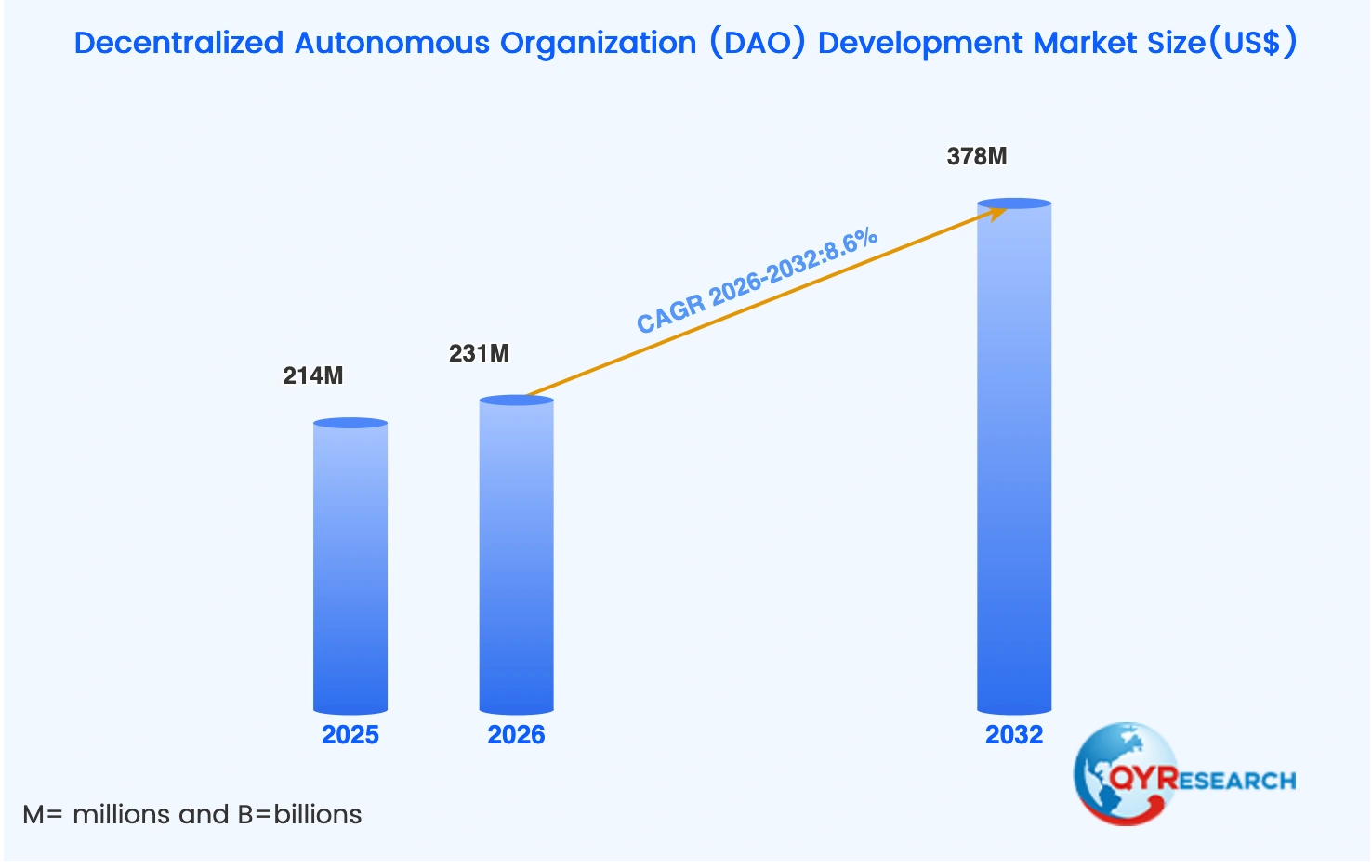
The global market for Decentralized Autonomous Organization (DAO) development was estimated to be worth US$ 214 million in 2025 and is projected to reach US$ 378 million, growing at a CAGR of 8.6% from 2026 to 2032.
What is a Decentralized Autonomous Organization (DAO)?
A DAO is an organization represented by rules encoded as a computer program that is transparent, controlled by the organization members, and not influenced by a central government. Rather than being governed by a central authority or executive committee, the DAO is owned and managed by its members, usually in terms of governance tokens. These tokens provide voting rights, which allow members to make and vote on proposals for the organization.
The “autonomous” part means that once smart contracts have been programmed to execute a specific rule, they run in perpetuity without the need for any human intervention. For instance, the smart contract could be programmed to release funds, modify parameters, or interact in some way if a proposal meets certain voting requirements.
At its core, a DAO is nothing more than a digital organization powered by code, led by community, and secured by the blockchain.
Core Components of a DAO
While the purpose and design of DAOs are diverse, several factors commonly underpin them.
Smart Contracts
The smart contract is everything in a DAO. They describe the governance rules, decision-making procedures, and operational financial requirements of the organization. They eliminate the intermediaries and reduce the need to trust anyone.
Governance Tokens
GA tokens are used to indicate ownership and voting rights in a DAO. Token holders can put forth proposals, vote on changes, and hold sway over the direction of the organization. Tuition and voting power often scale with the number of tokens held, but some DAOs try different models to combat centralization of power.
Treasury
Almost all DAOs have a common treasury, which is generally replenished through token sales, membership dues, or protocol fees. All treasury funds are 100% on-chain managed and can only be spent according to rules agreed upon by the community. This provides visibility and integrity for financial decisions.
Community and Proposals
DAOs thrive on active participation. Members submit projects for funding or make governance updates, and many other proposals. These suggestions are openly discussed, usually on forums or Discord channels, and then voted on via an on-chain process.
Types of DAOs
DAOs are not one-size-fits-all. Several classes have developed over time. Significant among them are:
Protocol DAOs
Decentralized Finance (DeFi) platforms and blockchain protocols are ruled by Protocol DAOs. This could be DAOs running lending platforms, decentralized exchanges or layer-2 networks. Parameters, including interest rates, fees, and upgrades, are approved through a vote by token holders.
Investment DAOs
Investment DAOs aggregate members’ funds to invest in startups, NFTs, or other crypto assets. Which startups to invest in is also made as a collective decision, thus reducing the barrier to entry for VC.
Social and Community DAOs
These are DAOs that center around common interests, like creators, artists, or online communities. Participants: Members work together, help fund each other’s creative projects, and manage pooled resources; in doing so, they frequently mix social belonging with economic incentives.
Service DAOs
Service DAOs are like decentralized companies offering services (development, marketing, etc.). Work is paid in tokens or stablecoins, and contributions are coordinated through proposals and task boards.
Benefits of DAOs
DAOs have a number of strong appeals compared to conventional models.
Transparency
Every transaction, vote, and rule is written to the blockchain and available for anyone to see. This level of openness is built on trust and minimizes corruption or mismanagement.
Global Participation
Users with internet access and tokens can participate in a DAO no matter where they are in the world. This allows for truly global cooperation and involvement.
Reduced Intermediaries
Many operations no longer require lawyers, banks, or centralized administrators once DAOs are in place. Execution is managed by smart contracts, reducing the expense and streamlining the process.
Community Ownership
In contrast to conventional companies, where power is centralized, DAOs do not have someone in charge but instead own it among their participants. This aligns the interests and incentivizes long-term commitment.
Challenges and Limitations
Notwithstanding their apparent potential, DAOs are not free of problems.
Governance Complexity
As DAOs get larger, decision-making can become slow or captured by large token holders. Lack of participation in governance is also rife, with a minuscule percentage of members being present to vote.
Security Risks
Smart contracts are code, and code is subject to bugs. Malicious actors and their attacks can result in huge financial damages, as evidenced by a number of high-profile DAO hacks.
Legal Uncertainty
DAOs tend to live in a gray legal area. DAOs are not legally established in many jurisdictions, and liability, taxation, and regulatory enforcement involve significant unknowns.
Centralization Risks
Ironically, some DAOs may end up with a certain level of centralization if their tokens are disproportionately skewed and early contributors wield too much power.
DAO Governance Models
To solve the decision-making problems, DAOs are trying out new types of voting.
Token-Weighted Voting
The very popular model of voting power is token-holding-based. Simple though it is, it can benefit more affluent participants.
Quadratic Voting
This mechanic causes the voting power to increase less on a percentage basis as large token holders gain power. It promotes wider participation and fairer results.
Delegated Voting
Users can delegate their right to vote to someone well-known, making things easier while maintaining decentralization.
Reputation-Based Systems
Some DAOs employ non-transferable voting power through reputation (scored for contributions, rather than financial stake).
Real-World Use Cases of DAOs
Decentralized Autonomous Organizations are not merely theoretical concepts anymore; in practice, they are revolutionizing many sectors. Through the use of blockchain and collective governance, decentralized autonomous organizations facilitate transparent, frictionless decision-making across a wide variety of real-world uses.
DAOs have a large presence in decentralized finance (DeFi), which is a subset of finance. DAOs govern billions in value spread out across lending platforms, decentralized exchanges, and asset management systems. It eliminates the need for a centralized bank or financial intermediaries by allowing token holders to vote on interest rates, risk parameters, protocol upgrades, and treasury allocation. It brings out the open financial system, and users use the platform by collectively managing it and benefiting.
DAOs empower creators by eliminating gatekeepers in art and media. These are artist-led DAOs that fund their creative projects, act as a co-op to purchase digital artwork and NFTs collectively, and share ownership of IP. The revenue from these assets is divided transparently between members, so everyone receives fair compensation and shared governance. It empowers artists to take responsibility and enables fans to back creative communities directly.
While in tech, DAOs are revolutionizing open-source development. Such developer-focused DAOs coordinate the legion of global contributors who maintain and improve our software and then reward those contributions based on measurable value to a project. Product direction, which features to prioritize, and how much funding to provide each initiative are all open decisions. This increases trust and accelerates innovation.
DAO can also allow donations to be handled with transparency in social causes and philanthropy. Pooling funds at the community level and voting on the allocation of resources ensures accountability and minimizes potential abuses. These implementations show that DAOs are a real organization with real economic and social impact.
The Future of DAOs
Over time, we foresee that DAOs will mature on the blockchain into further advanced legal types. We may come to see hybrid models where decentralized governance is combined with some aspects of a more traditional legal framework. Better tooling, a smoother experience, and clear regulation will remove barriers to participation.
DAOs have the potential to reshape the way companies are created, the way governments interact with their citizens, and the way global communities come together. DAOs are a nascent but audacious attempt to reconfigure trust, coordination, and power in the digital age.
The Future of Decentralized Governance Starts with Delta6Labs
A cutting-edge example of this DAO-driven innovation model is Delta6Labs, which is a Web3 development company collectively building out decentralized infrastructure and governance-first products. One way that Delta6Labs is accomplishing this as a DAO is by allowing anyone from around the world to contribute to protocol development, tooling, and experimentation without the need for any centralized corporation. Community proposals and on-chain voting govern strategic decisions, funding allocations, and road map priorities, aligning incentives between builders and stakeholders. In this way, Delta6Labs is able to iterate rapidly, reward contributors at a fair market price, and most importantly, maintain flexibility in the rapidly evolving blockchain landscape.
Conclusion
The principles of Distributed Autonomous Organizations directly oppose the structure and organization of the central ideologies that run our day-to-day governance systems. Despite numerous technical, legal, and social challenges that lie ahead, this unique ability to facilitate global, permissionless collaboration is unparalleled. With the rise of Hierarchical Institutions reformed to new alternatives, it is possible to see DAOs as the foundation for the new era of organizations, those that are open, inclusive, and that will be decided by the old who power it.